
Home / Blog / AI Chatbot Costs: Build, Platform, and Ongoing Spend
AI Chatbot Costs: Build, Platform, and Ongoing Spend
Discover the true cost of building and running an AI chatbot, from initial development and platform selection to ongoing maintenance and API usage. This guide breaks down the key pricing factors, including custom chatbot development, AI model costs, hosting, integrations, and support, helping businesses estimate their budgets, compare solutions, and choose a cost-effective approach that scales with their needs.
27 Oct, 2026
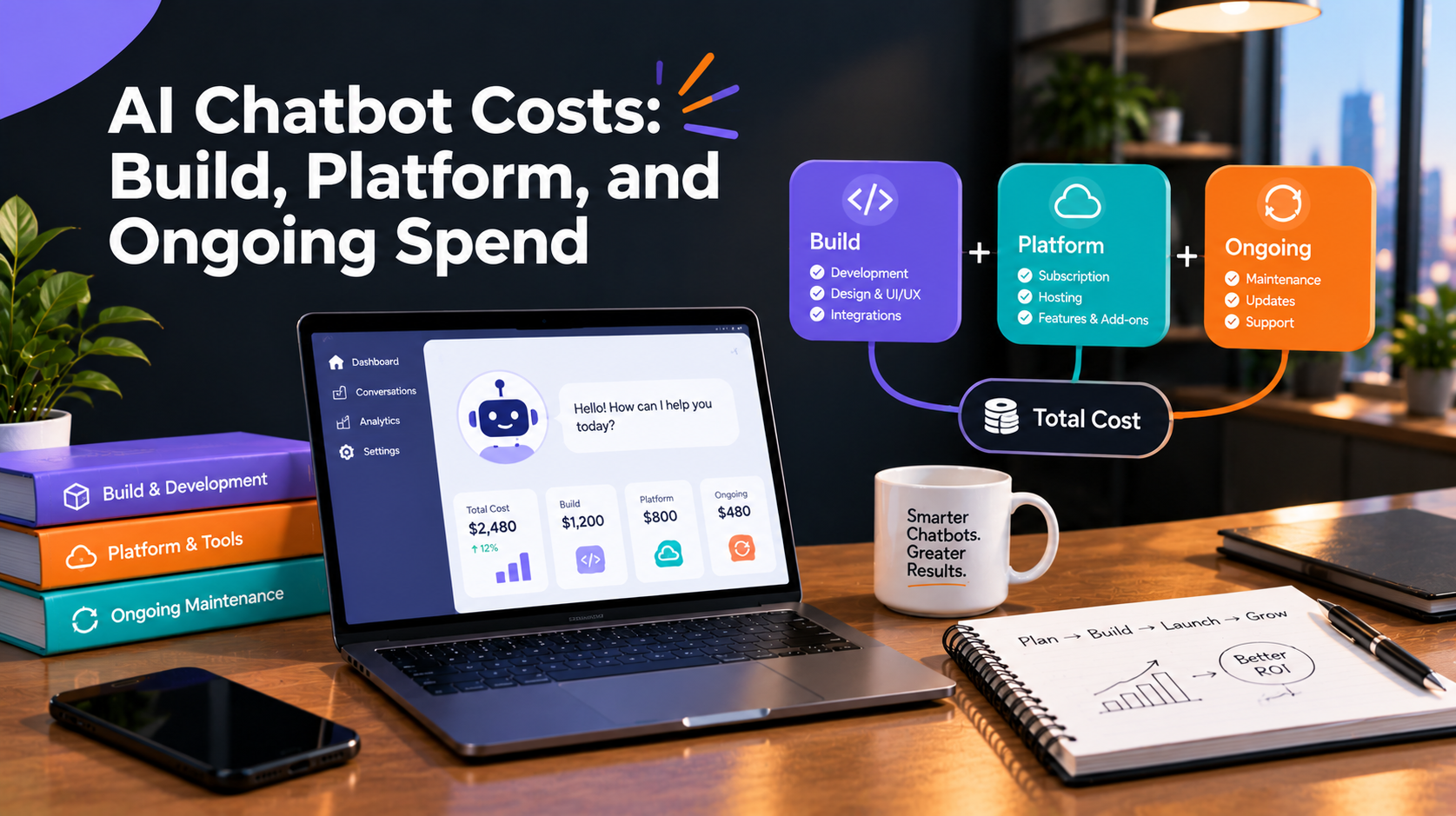
Two AI chatbot quotes can differ widely because they often price different things. One covers a configured platform subscription. Another covers a custom build with system integrations. A third leaves out usage fees and maintenance entirely. This guide separates AI chatbot development costs into build, platform, and ongoing spend, so you can see what each proposal includes before you compare totals. It does not quote fixed prices, because the right figure depends on scope, data, and how the chatbot connects to your business.
The three cost layers of an AI chatbot
Every chatbot project carries three kinds of cost, and they behave differently over time.
Build cost is the one-time work of planning, designing, configuring or coding, connecting, and testing the chatbot. Platform cost is what you pay to run it: software subscriptions, AI model usage, hosting, and messaging channel fees. Ongoing spend is the work after launch: monitoring, content updates, retraining, security reviews, and improvements.
A low build quote paired with heavy usage fees can cost more over a year than a higher build quote with predictable running costs. Ask for all three layers in writing, even if a provider only prices one of them as a project.
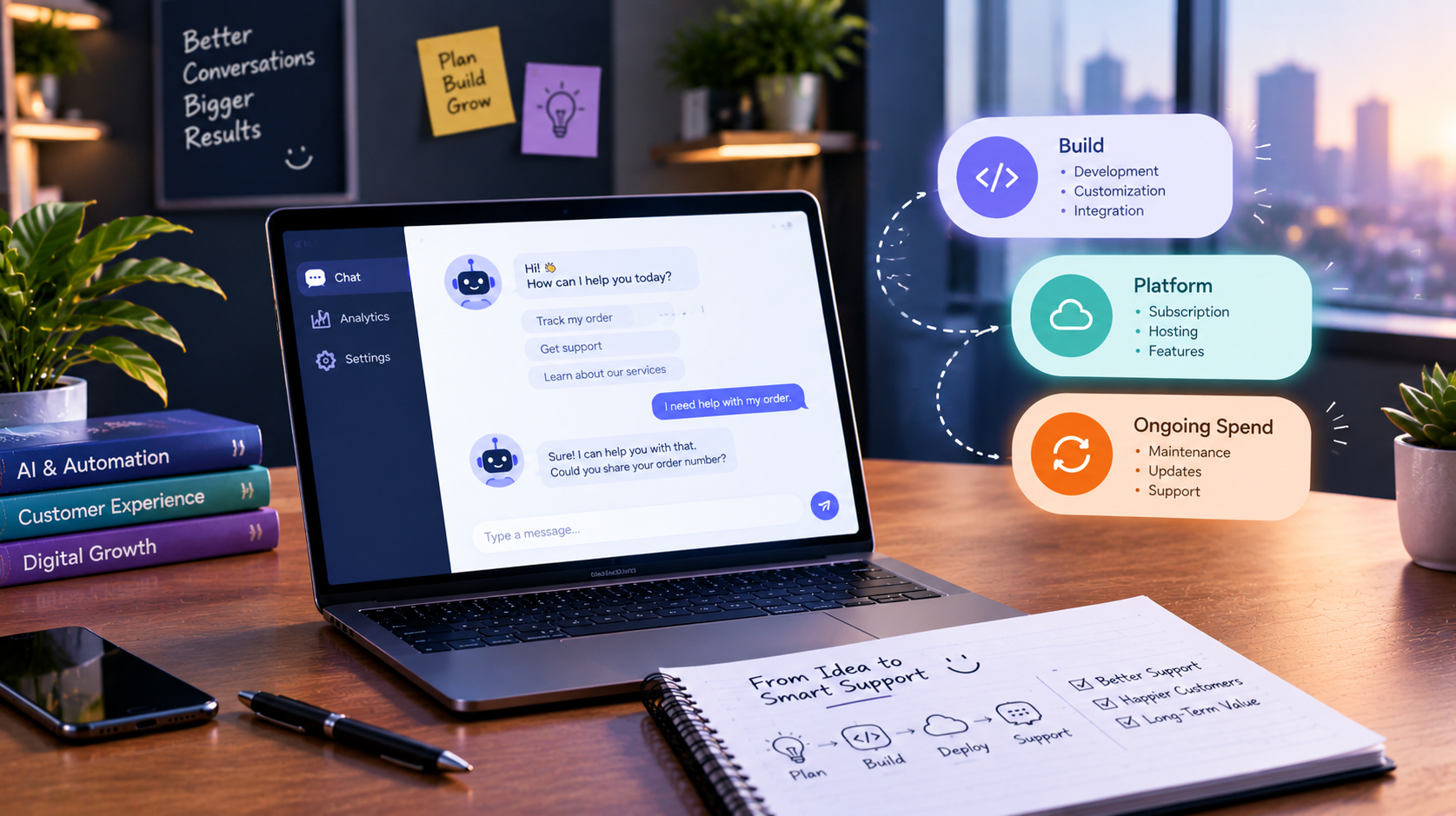
What drives the build cost
Build effort depends mostly on what the chatbot is expected to do. A bot that answers common questions from an approved help center is a smaller job than an AI agent that checks order status, updates a CRM record, books appointments, and hands conversations to a person.
The factors that move build cost most:
- Scope of tasks: Answering questions, collecting leads, and completing actions inside other systems are three different levels of work.
- Knowledge sources: Clean, current documentation is easier to work with than scattered PDFs, outdated pages, and tribal knowledge. Preparing content is real work and is often underestimated.
- Integrations: Every connection to a CRM, helpdesk, booking tool, payment system, or internal database adds design, security, and testing effort.
- Conversation design: Tone, fallback behavior, escalation rules, and edge cases take planning before any code is written.
- Channels: A website widget, WhatsApp, email, and a mobile app each have their own requirements.
- Security and compliance needs: Handling personal or sensitive data affects architecture, access controls, and review time.
The user experience matters here too. A chatbot that gives accurate answers in a confusing interface still frustrates people, which is why good [user experience design](CONFIRM URL) belongs in the build scope rather than being added at the end.
Platform and usage costs
Platform pricing varies by vendor, and the pricing model matters as much as the number. Common models include a flat monthly subscription, pricing per seat, pricing per conversation or resolved conversation, and usage-based pricing tied to how much text the AI model processes.
Each model carries a different risk. A flat subscription is easy to budget but may cap features or volume. Per-resolution pricing can look affordable at low volume and grow quickly as traffic rises. Usage-based model pricing tends to rise with longer conversations and larger knowledge bases.
Before choosing a platform, estimate your own conversation volume, average conversation length, and expected growth. Then ask how each vendor charges at three times that volume. Vendor pricing changes often, so confirm current rates directly with the vendor rather than relying on a figure from an article.
Ongoing spend after launch
A chatbot is not finished at launch. Products change, policies change, and customers ask questions nobody planned for. Ongoing work usually includes:
- Reviewing conversations to find wrong answers and gaps
- Updating the knowledge base when pricing, policies, or products change
- Adjusting prompts, rules, and escalation paths
- Monitoring accuracy, security, and integration health
- Handling changes when connected software updates its interface or API
Some businesses handle this in-house. Others pair the chatbot with a support arrangement. Either way, budget time for it. A chatbot that nobody maintains slowly drifts away from what your business actually says and does.
Costs that are easy to miss
Several items rarely appear in a first quote:
- Internal time: Your team will spend hours supplying content, reviewing answers, and testing.
- Data cleanup: Messy source material needs to be organized before a chatbot can use it well.
- Human handoff: If the chatbot passes conversations to staff, your support process needs to be ready for that.
- Testing and review: AI output requires appropriate human review, especially for answers involving pricing, legal terms, or health and financial topics.
- Scaling: More languages, more channels, or more integrations later will add cost.
- Switching platforms: Moving a chatbot between vendors later can mean redoing configuration and conversation design.
Build on a platform or build custom?
Neither route is automatically cheaper. A configured platform usually gets a simple use case live sooner and with less up-front spend, but you accept the vendor’s limits on customization, data handling, and pricing changes. A custom build costs more to start and gives more control over integrations, behavior, and how your data is handled, which can matter when the chatbot sits inside a larger workflow.
A practical way to decide: start with the job the chatbot must do. If it only needs to answer questions from approved content, a platform may be enough. If it must act across your CRM, ordering system, and internal tools, custom work or a hybrid approach is worth pricing. 10turtle’s AI agents and chatbot development work covers both situations, whether you are building a chatbot from zero or rebuilding one that is not performing, and the right route depends on your workflow and data rather than a preset package.
How to compare chatbot proposals
Put every proposal into the same table before you compare totals. List the one-time build fee, the monthly platform fee, the usage or conversation pricing, the support or maintenance terms, and what is left out.
Then check four things. First, whether the scope names the actual tasks and integrations, not just “AI chatbot.” Second, whether testing and accuracy review are included. Third, who owns the configuration, prompts, and conversation data if you leave. Fourth, how pricing changes if volume doubles. A proposal that answers all four clearly is usually easier to trust than one with a lower headline number.
One structural point also affects total cost. When chatbot design, website changes, branding, and system integrations come from separate vendors, gaps between them become your project management cost. 10turtle positions itself as one accountable partner with dedicated specialist teams across web, branding, and AI automation, which can reduce handoffs when a chatbot touches several of those areas.
Questions to ask before you request a quote
Having answers to these first will make quotes more accurate and easier to compare:
- What specific tasks should the chatbot complete, and which should go to a person?
- Which systems must it connect to?
- Where does the answer content come from, and who keeps it current?
- How many conversations do you expect each month, and in which channels?
- What data will it handle, and what privacy requirements apply?
- How will you judge whether it is working?
If you are not sure where automation fits in your workflow, a free audit from 10turtle is one way to review automation opportunities and prioritised improvements before you commit to a scope.
Frequently asked questions
How much does an AI chatbot cost?
It depends on scope, integrations, knowledge sources, and the platform or model used. A simple FAQ bot on a subscription platform sits at one end, and a custom AI agent connected to several business systems sits at the other. Request itemized quotes covering build, platform, and ongoing costs.
Are AI chatbots expensive to maintain?
Maintenance cost depends on how often your information changes and how complex the integrations are. Expect regular work on reviewing conversations, updating content, and monitoring accuracy. Chatbots that handle changing products or policies need more upkeep than ones that answer a fixed set of questions.
What is the difference between chatbot platform fees and development costs?
Development costs are the one-time work to design, configure, integrate, and test the chatbot. Platform fees are recurring charges to run it, such as software subscriptions, AI model usage, and hosting. Both apply to most projects, and a proposal should show them separately.
Is it cheaper to use a chatbot platform or build a custom chatbot?
A platform is often cheaper to start, especially for simple question answering. Custom development can make sense when you need deeper integrations, specific data handling, or control over behavior. Compare total cost over a year or more, including usage fees and maintenance, not just launch cost.
Will an AI chatbot reduce my support costs?
It may help by handling repetitive questions, freeing staff for complex cases. Results depend on content quality, workflow design, and ongoing review. Treat any savings estimate as a hypothesis to measure after launch, not a guarantee.


_1_11zon-1758181054011.webp)