Home / Blog / Print vs Digital Marketing Materials: Where Each Still Wins
Print vs Digital Marketing Materials: Where Each Still Wins
Discover the key differences between print and digital marketing materials and how each can help your business reach its target audience. From brochures, flyers, and business cards to websites, email campaigns, and social media content, explore the strengths of both approaches. Learn when print creates a lasting impression, where digital marketing offers greater reach and measurable results, and how combining both strategies can improve brand visibility, customer engagement, and overall marketing effectiveness.
26 Oct, 2026
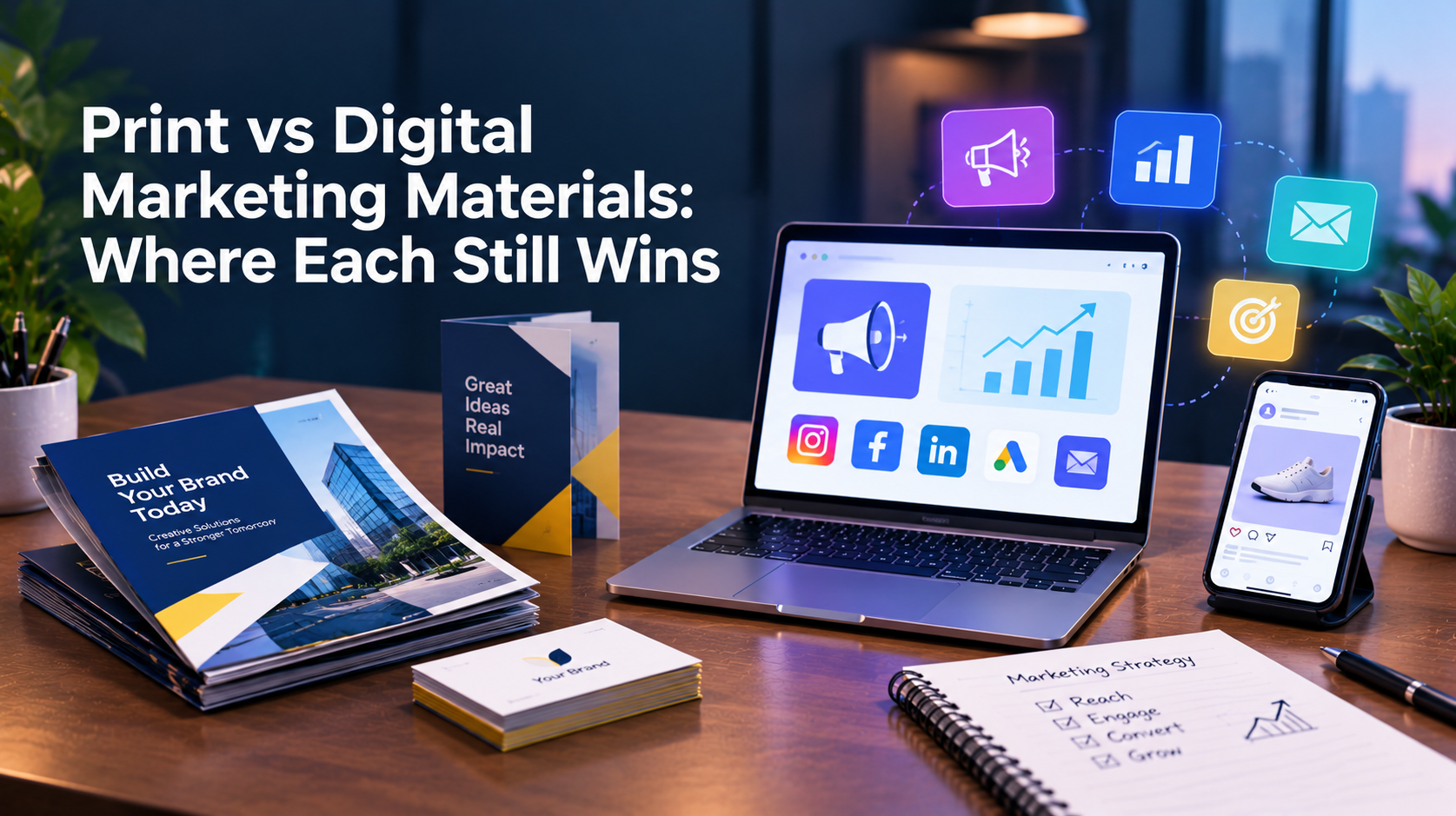
Most marketing teams no longer debate whether to go digital. The harder question is which pieces still deserve a print budget, and which printed items should have moved online years ago. Print vs. digital marketing materials is less a contest than a sorting exercise, because each format does some jobs well and others poorly. This guide compares them by cost, flexibility, and fit, then gives you a checklist for deciding what your business should produce first.
Quick Comparison Overview
Where Each Option Is Strongest
Print works best when the moment is physical. A trade show table, a retail shelf, a leave-behind after a sales meeting, and a package arriving at a customer’s door are all situations where someone can hold the item. A well-made printed piece also signals effort, which matters in categories where trust is built face to face.
Digital works best when the audience is scattered, the message changes often, or you need to know what happened afterward. A promotion that runs for two weeks, a product page, an email sequence, and a social campaign all benefit from being easy to edit and measure.
A useful way to separate the two: print holds attention for a smaller audience, while digital reaches a larger one with less attention per person. Neither claim holds for every brand, so test against your own audience.
Cost and Resourcing Considerations
Print costs more at the start and again each time you reorder. You pay for design, proofing, materials, finishing, and shipping, and a mistake found after printing means paying again. Digital shifts the cost toward design time and ongoing production, such as resizing assets for each channel and keeping them current.
Resourcing differs too. Print needs lead time and someone who understands production details such as bleed, resolution, and color modes. Digital needs steady upkeep, since outdated pricing or an old logo on a live page does damage quickly.
Long-term cost depends on volume and lifespan. A printed catalog that stays useful for a year may be economical, while the same catalog printed for a product line that changes monthly is wasteful. I am not quoting figures here because they vary widely by quantity, materials, and market.
Scalability, Flexibility, and Limitations
Digital scales easily. One approved template can become dozens of variations for different audiences. Its limits are attention and sameness: audiences scroll past a lot, and templates reused too often start to look like everyone else’s.
Print scales poorly but ages differently. You cannot correct a typo after 5,000 copies are boxed. On the other hand, a printed piece does not get buried by an algorithm or lost in an inbox.
Both formats share one limit: neither fixes unclear positioning. If the message is vague, a beautiful brochure and a polished email will both underperform.
Which Option Fits Which Business
- Local service businesses often get value from both: printed cards, flyers, and vehicle or shop signage for nearby discovery, plus digital assets for search and social.
- Startups with small budgets usually begin digital, because changes are cheap while the offer is still being tested. Add a small run of print for events and sales meetings.
- DTC and product brands should treat packaging and inserts as marketing materials, since they reach customers at a high-attention moment.
- B2B and professional services often rely on digital decks and email, with printed leave-behinds for high-value meetings.
Decision Checklist
- Where will the audience actually meet this piece: online, in person, or in the mail?
- How long will the content stay accurate?
- Do you need to measure results directly?
- Is there a production lead time you can afford?
- Can you reuse the same design system across both formats?
- What happens if you find an error after launch?
If most answers point to speed, change, and measurement, lean digital. If they point to presence, permanence, and a physical moment, lean print.
How This Applies to Your Brand Program
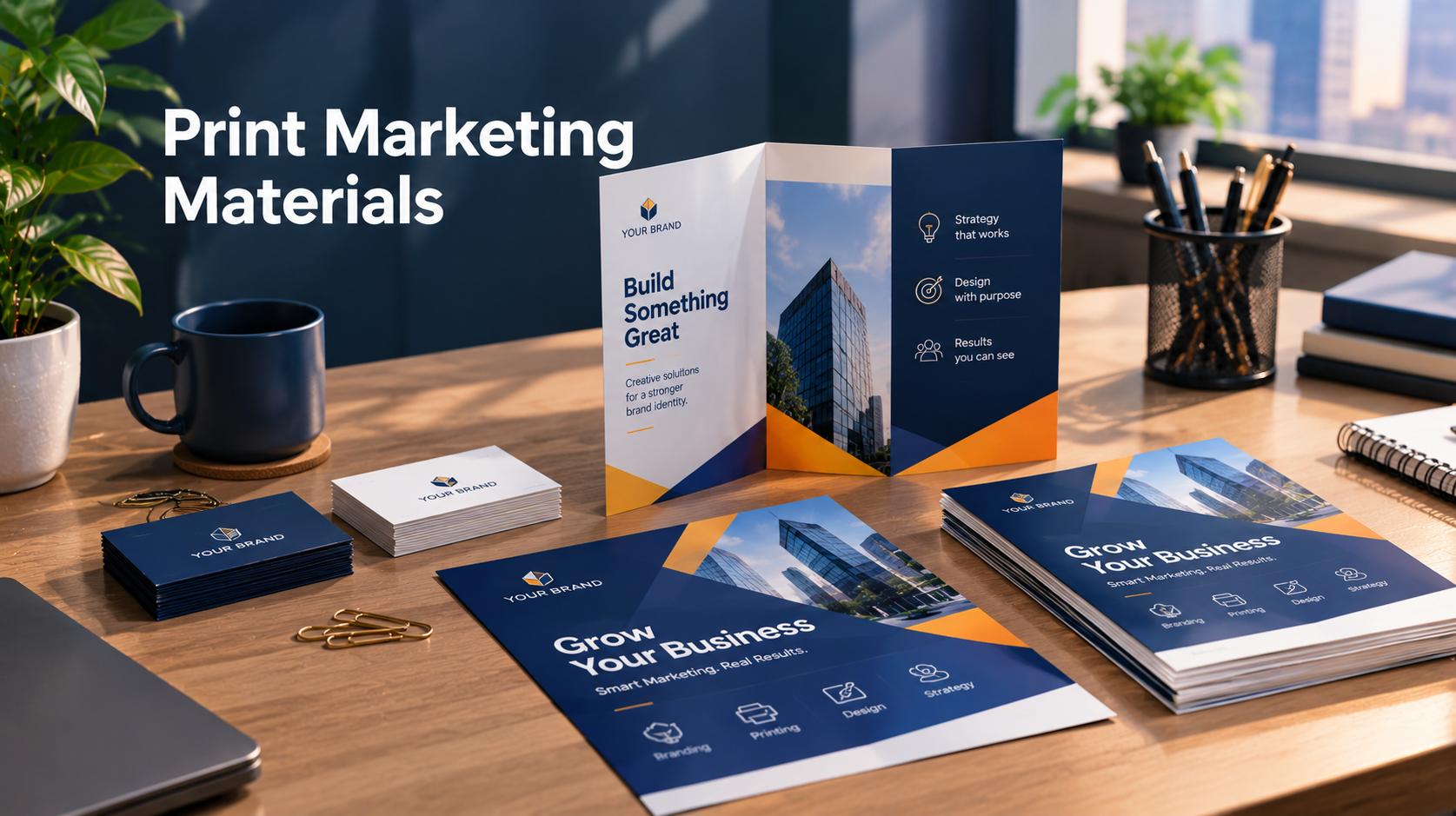
The bigger risk is not choosing the wrong format. It is producing both without a shared system, so the brochure, the website, and the social graphics each look like a different company. A consistent brand identity with defined colors, type, and layout rules keeps print and digital pieces recognizable as one brand.
This is where 10turtle’s model applies. Print and marketing materials sit alongside web and branding work, handled by dedicated specialists and coordinated under one accountable partner, which reduces the mismatch that appears when separate vendors produce separate pieces. If you want to see where your current materials are inconsistent, the free audit reviews areas including brand consistency. For a sense of what is involved in producing printed collateral, see our marketing collateral design work.
Frequently asked questions
Which option is better for a small business on a limited budget?
Digital is usually the lower-risk starting point, since you can edit and test messages cheaply. Add print selectively where a physical moment matters, such as events, client meetings, or local signage. Start with a small print run so you can correct mistakes before ordering larger quantities.
Can I switch later if I choose the wrong one?
Yes. Digital pieces can be changed immediately, and print can be reprinted. The real cost is wasted production on a large print run, so begin small. If your brand guidelines are clear, moving effort from one format to the other is much easier.
How do long-term costs compare?
Print costs grow with quantity, and each reorder, while digital costs are mostly design and upkeep. Print can still be efficient when a piece stays accurate for a long time. Digital can become costly if assets need constant updating across many channels.
How do we keep this consistent across digital and print?
Use one set of brand guidelines covering logo use, color, typography, imagery, and layout. Build templates that work in both formats, and review printed proofs next to on-screen versions. A shared asset library also stops teams from using outdated files.